Tuesday, May 6, 2014

Extra Credit Visions and Voices (5/1): "New York is Like Johannesburg"

This event was excellently crafted to demonstrate the similarities of racialization between New York and Johannesburg.   Visions and Voices used both conversation with a panel of five ethnic individuals and with a live performance by successful hip-hop artist Jean Grae.  Throughout the event the speakers examined the structured inequalities towards races in both countries.

These structures they referred to are very similar to many of the institutional aspects of race we have examined in both our writing course and the complimentary AMST 274 classes. All the speakers,  specifically Johan Ferenandez who is a professor of 20th century US History of social movements, examined the impact of race, labor, laws, and law enforcement and how the perpetuate racial inequalities.  They discussed how laws like stop and frisk are evidence of the imperfections of democracy and how racial groups can be left out.  People of ethnic background had very little say in the institution of this law, however they are the one's who see its effects daily.  Stop and frisk, and other laws that allow for racial profiling, allow for police officers to abuse the laws at the expanse of ethnic individuals.  While stop and frisk is a major issue in the United States, there was similar police racial profiling in South Africa in what amounted to the Marikana Massacre.  This event was brought up during the discussion and the panel decided that this was simply an act of the government allowing officers to get away with mass murder of black employees.  The event started when South African miners went on strike and it ended in the history books as the most lethal use of force in South Africa's history.  The panel compared the Marikana massacre to structures in US society that create a rift in equalities not only of race, but also between the government and its people.

To make the connection between the US, New York, and Johannesburg the panel examined the racial murders in South Africa and the prison system in the United States.  Jean Grae said the prison system in the United States is extremely unequal to races and she used the example of how stop and frisk policies brings a "prison to a neighborhood near you."  Of course, prisons will not be coming to the white neighborhoods, but rather the ethnic inner cities.  She furthered her statements by illustrating how there is an extreme gap in the United States between perceived and given freedoms.

The panel of thinkers all disucssed how they were introduced to the racial ineqaulties of both South Africa and the United States.  They all were ethnic individuals and were made aware of the societal workings of race through public figures like Muhammed Ali, books such as "Huckleberry Finn," and through schooling and political action groups.  Although the panel had diverse upbringing it resembled the panels examined in A5 for ineffectiveness: there was not enough racial variation in order to have a productive discussion about race.  However, it was useful because this panel was not comprised by a News Station to illustrate racial events in society to the public, but rather to educate curious students, so in that sense it worked. 

This event was very well put together and was very closely connected to many themes we have discussed in both classes throughout the years.  They centered the discussion around the workings of institutions in society such as race, labor, and laws and how they continue to create a rift in racial inequality in society.  The troubling part is that these structures are created by the government showing the gap between perceived freedoms and actual freedoms felt in society. 


Monday, May 5, 2014

The Year End: A Retrospective

I cannot believe this class has come to an end, along with Freshman year as a whole.  This class was awesome for many reasons: it improved my writing, it taught me how to do diligent research before I began, and it showed me the importance of constant revisions to my papers.  Coming into the class, I would generally look up some background information on a topic and then begin writing.  However, this class gave students the ability to explore various invention strategies to plan out essays.  In addition, the blogs were very helpful because they were a source of preliminary writing on a subject, and it also allowed us to see what classmates were writing about though the commenting groups.  I noticed this drafting strategies gave my paper a greater clarity. 

It was a great tool having a class period in the library because it opened my eyes to all the resources available at USC.  The libraries feature so many documents, articles, and sources and it has been great being able to utilize them.  I, now, use these tools for all my classes.  Research greatly improves a paper because it supports the arguments being made (and not resorting to bad faith arguments like we just examined in A5).

I plan to apply all the writing tools I have learned this semester in all future academic endeavors.  Writing is extremely an extremely powerful form of communication that is valuable no matter what field I plan to pursue a career in. This class has been an excellent experience and improved me as a student in many aspects.  I truly enjoyed our class discussions and how we critically examined many racial and ethnic issues within society.

Thanks for a great class and an awesome ending to my Freshman year!!

Saturday, April 26, 2014

Extra credit Blog Post: Visions and Voices presents: Mehfil Massive

I attended the event put on by Visions and Voices called Mehfil Massive: South Asian Religions Remixed Through Poetry and Music. I was unsure what to expect of the event, especially at the start of the event. The speaker, popular actor and comedian D'Lo began by asking where everyone in the audience was from. The geographical breakdown of the audience was mostly South East Asian and Indian. D'Lo is a Sri-Lankan, while many performers where from North and South India, and other regions. It was an extremely diverse crowd and I have to admit I had felt a little out of place as one of the few whites there. For once, whites were the minority and it was interesting to be in this perspective. I kept thinking to myself how it would be like to live as a minority and how it is always a struggle to fit in with the crowd and be accepted by white, American society. When D'Lo was scanning the crowd calling out regions of South Asia, I did not fit into any group and I could see how this translates to society.  If you do not fit the mold of an ethnciity, similar to the 3rd Rock from the Sun episode on identity, society forces you to try to join one to give yourself an identity. I can understand how difficult this would be, to be labeled and associated with the stereotypes of an ethnicity that does not describe your true racial background.

The show featured five performances. Each was an ethnic musical artist who would be complimented by a poet, both representing the specific culture they were from through their words and music. My favorite performer was Kazim Ali and Salman Ahmad, who have performed alongside popular ethnic artist Wyclef Jean--from Haiti. I enjoyed their performance because of the upbeat music as well as cheerful lyrics. Ali instructed gave some advice to the crowd in order to help improve his performance: live in the present moment. I enjoyed his advice and I think had a correlation to appreciate his music more. His reason for this was because when everyone is present in a moment it creates what he calls "mythical ecstasy" and frequently engaged the audience and even had us sing-a-long with him in a chorus to encourage this.  The whole show was a celebration of South Asian religion and music.

It is interesting to note the prevalence of students from this ethnicity at USC, and as a result USC has more international students from South Asian regions than any other college. This statistic reminded me of our class as well as AMST 274. The show featured many aspects of race and ethncity that we discuss in both classes. For example, D'Lo was explaining how her mother would not allow her to play in the front yard as a child because she feared the KKK abducting her. D'Lo comically remarked how the KKK would not want a Sri-Lankan, but nonetheless it shows how certain races live their lives in fear of aspects of society. When D'Lo was finally allowed to play in the front yard she remarked how her mother was like the "American government to the Indians, you can have this tiny piece of land to play on, but we're going to watch you." This example shows how societal institutions govern our lives and the unseen affects they have on races.

 D'Lo frequently alluded to many stereotypes prevalent in society for comedic effect, but they also had a deeper meaning. It shows how although we laugh at these stereotypes, they still exist and have an effect on the ethnicities. For example, she made a couple jokes about her mother and even dressed in disguise as her mom for one set. After, when D'Lo back out her moms character came back on stage said her "mom" told her how the audience was very nice "North Indians." This a joke playing on the fact that North Indians are of lighter complexion than South Indians and because her "mom" saw white people she assumed they were North Indians. This joke illustrates how people make judgements about people based on their connotation, and although not correct they influence how an individual views them. D'Lo also touched on her time spent in Sri-Lanka and how Sri-Lankans do not see white people as superior. She attests this to the fact that there are not many whites in Sri-Lanka and because of it they do not grow up with skewed power relations, such as the social hierarchies in American society. It was apparent D'Lo favored the individuals in the crowd who were from a similar ethnic background as her. She often made jokes celebrating their culture, while also making some jokes at other ethnicities expense. She made one joke in particular about light skin that only about a fourth of the audience laughed at, presumably the Sri-lanks and South Indians, and she followed up by saying "I guess you have to be South Indians to get that one" which created a separation between the audience based on ethnicity and color. It was interesting to be on the opposite end of the joke and how it oscracized a group of people, all because of a joke about stereotypes.

In looking back on the event, it was an extremely well put together event. All the performers were extremely talented and each one told a different story through their music with subjects ranging from the struggle to find identity, overcome hardships, survival, search for prosperity, and belonging to a culture. I wish they would have discussed the performances in greater depth so the audience could get a full understanding of the religions and cultures depicted. Sometimes the musci and poems were too quick to get a full understanding of the conveyed message. Nonetheless, I learned a lot from this event about South Asian cultures, and many topics discussed paralleled our discussions in our class as well as AMST 272. Here is a link to D'Lo's page: http://dlocokid.com/

Thursday, April 24, 2014

A5 Blog #2: Audience

The audience plays a very critical role in discussions. First of all, all sides of the rhetorical situation must focus their facts and arguments to suit the viewpoint of those in the audience. In public discussions or debates, one does not try to sway their opponents viewpoints to their side, but rather they want to convince the audience that they are right and to fall in line with their beliefs. For example, in the Presidential debates Obama was not convincing Romney to join the democratic party, but rather he was trying to convince those unsure of where they stand politically to vote for him. Both candidates did so by appealing to the audience on various subjects. The audience determines the direction in which the discussion goes before it even starts because both sides have to attempt to say what the audience wants to hear. Also, the audience can shape the conversation by giving an advantage to one side, while forcing the other to fell as if they are losing the argument--which is when people tend to resort to bad faith argumentation of logical fallacies, lies, and personal attacks. Another way the audience impacts the ethics within a rhetorical situation is by control. The audience ensures that no party steps out of line and completely bashes a party or does anything too crazy. Having an audience makes people be conscientious of their actions for fear of public out-lash, which would ultimately hurt their own image, as well as the viewpoints they represent. If there was no audience, it would be interesting to see how discussions would change. I think they would completely lose structure and purpose where people instead resort to verbal fighting, while making no progress on the discussion of the debated subject. What do you think and how large of an impact do you think the audience has?


            This image, taken from the 2008 Presidential Debate shows how Mitt Romney is actively appealing to the audience.  Mitt answers tot he audiences' questions in a manner to persuade them to vote for him.

Wednesday, April 23, 2014

A#5 Blog #1: Bad Faith Arguementation

Bad faith argumentation unfortunately continues to plague the arguments people have with one another.  This argumentation is not rewarded in public discussions, but neither does it have to be.  People resort to bad faith arguments when they feel like they are losing the battle, want to take divert the subject, or launch a personal attack on their counterpart.  The latter, I believe, is the most common tactic used today.  Whenever people engage in an argument whether it is in class, on a forum, or social media people are extremely quick to attack the other party as an attempt to discredit them and their argument. 

It is not necessary for discussion to turn into arguments.  Discussions are vital to enhancing one's understanding of a topic by being able to formulate their thoughts as well as hear the oppositions side.  However, peaceful and intellectual discussions are more frequently turning into heated arguments.  This is because of bad faith argumentation--where people will argue about the bad aspects of the oppositions stance, rather than the good found in their beliefs.  This tends to anger people because of its attack on not only the person, but also their beliefs.  People also throw out facts with no proof, allowing people uneductaed on the subject to join in on the argument, moving father and father away from constructive discussion.


I found a clip to examine featuring Bill O'Reilly and a counter-attack of his launched against Jon Stewart.  In the clip, O'Reilly criticizes Stewart for taking his clips out of context, and spinning them in Stewart's favor to appeal to his 45% liberal audience (a statistic of O'Reilly's).  However, when O'Reilly illustrates this point, he is extremely hypocritical because he ends up cutting the clips short, thus taking them out of context as well.  O'Reilly then takes an attack at Stewart's credibility by calling him a satirist as another attempt to diminish any truth found in Stewart's arguments.  The clip cuts back to an interview containing the two where O'Reilly says Stewart is "paid to cheap shot people" illustrating yet again another personal attack on Jon Stewart as an attempt to discredit his beliefs, and career all together.  O'Reilly is known for using bad faith arguments and it is shown in the clip.  

An example of a type of bad faith argumentation: name calling.

Tuesday, April 15, 2014

A4 Blog #2: Is Devil in a Blue Dress a noir film?

Yes, the film Devil in a Blue Dress is a noir film.  It has many characteristics representative of the genre: lighting, race relations, crime, and even femme fatale.  However, director Carl Franklin extends the film beyond traditional noir boundaries.  He places the setting in the inner cities of Los Angeles in the racially tense 1940s.  In doing so, it sheds light on societies lack of acceptance of minority races during that time.  Whites forced blacks, and other ethnicities, into the inner cities while whites moved to the flourishing suburbs.

Devil in a Blue Dress extends the genre of film noir by allowing minorities to tell the story while controlling their image in cinema.  Carl Franklin is able to accurately illustrate 1940 American society by placing the film behind the color lines, where whites were afraid to go--the inner cities.  The viewers learn many things from the film specifically how distinct the social hierarchy is.  Whites are clearly dominant so much so that people, such as Daphne Monet, completely shed their identity to act white in hopes of equal treatment.  Next, is the rest of the population: inferior ethnic individuals who serve to the whites.  For example, the white detectives bully Easy and force him to do their dirty work for them.  As a result Easy not only gets paid money he needs to survive, but in doing so he uncovers many deep secrets from the shadows and also gets involved with many crimes and deaths.  These are all characteristics of a typical noir film, yet Devil in a Blue Dress extends the genre by placing more emphasis of the lives of minority races. 
Dr. Keeling frequently discusses the impact of ethnicity on the "life chances" given to an individual and Devil in a Blue Dress along with the film Amreeka display the effects of the unequal life chances given ethnic individuals.  Easy works as a detective by doing the dirty work for white investigators to simply make enough money to pay his bills, and Muna similarly struggles to find adequate work once she immigrates to the United States.  Despite having two degrees and over 15 years of banking experience, enough to give one a good "chance" of finding work, Muna cannot find a banking job and ends up working at a fast food restaurant.  Both films illustrate the lack of equality in opportunities given to minorities.


Here is a photo showing the woman with 2 degrees and 15 years of Banking experience thrilled to have the "chance" of working at White Castle.  She must take any opportunity given by white society to try to succeed in their society.

Sunday, April 6, 2014

A4 Blog 1: Eric Lott's Whiteness of Film Noir

I read an article written by Eric Lott, "The Whiteness of Film Noir" to compliment my understanding of Noir based on the articles we've read, movies watched in class, as well as discussion.  The article analyzes film noir as a film containing an interest in blackened lives and frames to depict racism of 1940's American Life.  Film noir serves to illustrate the differences between perceived racial differences and stereotypes, a topic widely popular in film.  Lott states, "At a moment when bold new forms of black, Chicano, and Asian activism and visibility confronted resurgent white revanchism and vigilantism, film noir's relentless cinematography of chiaroscuro and moral focus on the rotten souls of white folks" to illustrate the struggle between light and dark depictions in film.  This article has reaffirmed what we have learned of how film noir uses lighting and other visual effects to represent how the color of one's skin determines the stereotypes placed on an individual, where it is favorable to be "light".  In this aspect, film noir celebrates those with a light phenotype while doing the opposite for their darker skinned counterparts.

Lott examines the role of women in film noir--a prevalent idea we have already examined in class.  The femme fatal, or  as Lott refers to it female power, is the power given to women in the films and because of this they skew societal relationships.  Women often prey upon men in these films such as the film, The Devil in a Blue Dress, where Daphne Monet has a great amount of influence and causes many unnecessary deaths because of her power.  Lott furthers the examination of women in film noir by stating, "the feminist critique of noir constitutes the most far-reaching account of the self's partitioning (into good/masculine and evil/feminine) in this run of American film and without it our understanding of noir would be impoverished indeed."  It is the portrayal of good/masculine and evil/ feminine that I have paid particular attention to in film noir and has been further brought to my attention thanks to Lott's article.
Here is an example of a femme fatal character common in noir films.  Also, notice how obvious the lighting is, another important aspect of film noir. 


From reading Eric Lott's article I was able to learn and get a better understanding of film noir.  Specifically, how racially charged this genre was.  The white favoritism is apparent through the lighting and depiction of the characters in the films.  On the other hand, the film would use darker scenes and lighting when showing people of darker races to give the feeling an impending crime or something bad is about to occur.  I am very interested in how film noir represents the desire for directors of these 1940'S films to perpetuate existing racial stereotypes in film.


Lott, Eric. "The Whiteness of Film Noir." Whiteness: A Critical Reader. Ed. Mike Hill. New York: New York UP, 1997.  81-101

Wednesday, April 2, 2014

Speaker Series: Andrew McGuire

I thoroughly enjoyed listening to Mr. McGuire speak.  He is clearly an extremely successful individual in his advocation for improving safety standards for all people.  His powerful passion stems from personal experience and his desire for people to not have to endure the difficulties he did.  I've grown up wearing flame resistant pajamas without even knowing it, and the person responsible for this was speaking on a stage only four rows in front of me.  Mr. McGuire successfully caused one of the most powerful and stubborn industries--tobacco--to change its ways that it has been using since the start of their industry.  I was amazed by the efforts taken by the tobacco industry to avoid changing their product to make the cigarettes self-extinguishing simply because they do not care about the safety of their consumers and the general population.  "Project Hamlet" shows the tobacco companies awareness of the self-extinguishing campaign led by McGuire and after they did several tests to see whether or not the science works, or if it affects the taste/ enjoyment of the cigarette (it did not), they simply kept the improved cigarettes on the shelf until they were forced to use them.  I could not believe this, however it shows the complete lack of ethics and morals widespread through tobacco companies and how could they?  They have one of the deadliest industry in the world.

Another thought that caught my mind during the presentation was what else could have Mr. McGuire achieved had he not had to fight the tobacco industry for so many years.  He is extremely well connected to many burn doctors and surgeons, countless Fire Marshal's, and numerous health services and associations, even many media reporters which allows his a strong arsenal of support in any cause he undertakes.  For these reasons, he was highly involved in making seat belts and airbags mandatory in all vehicles through the California Sunset Clause.  I am curious to see if he takes any action, or if he could have if he didn't have to fight the tobacco companies for so long, to prevent wildfires and other fires (like the student who had a balcony fire) through further improvements to cigarettes.  I hope he does he is a person with a great ability to create positive change.

Here is a page describing the accomplishments of McGuire: http://pnhpcalifornia.org/andrew-mcguire/ 

Wednesday, March 12, 2014

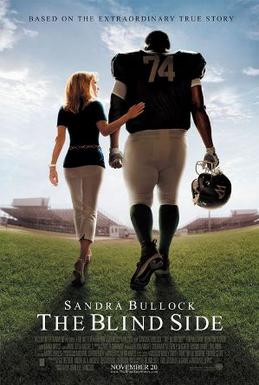
A3 Blog #2- Article Reviews and Analsis of The Blindside

I was not aware of the prominence of white saviors in film until the prompt for our third essay was given to us.  I knew there are many film where whites are portrayed as superior and play these heroic roles to help minority races.  For instance, my sister loves the movie Freedom Writers which features another prominent white savior.  I was slightly surprised that there is such a strong prevalence in film of the white savior/ magic negro to the point where it is practically a genre.  However, after my research of many articles reviewing The Blindside it is apparent the white savior is a well know theme in cinema.

All of the reviews featuring The Blindside are critical of how prevalent Sandra Bullock's role of the white savior is.  It is so dominant, blatant, and powerful she becomes the true focus of the film and not the courageous story of Michael Oher.  For instance, one critic notes how Bullock frequently asks her husband, "Am I doing the right thing" showing how she is the one facing a dilemma and must ovr-come some obstacle.  Yes, Sandra it is the right thing to help this young African American teenager and enable him to succeed, but it is wrong to steal his story and make it into a story about your greatness.

Critics also point out in their reviews how the film blatantly ignores many important facts described by Michael Oher in his account of the story.  One such example is how Michael is portrayed in the film.  He is cast as a big, dumb, and practically lifeless individual.  He lacks hope and knowledge.  While he was hopeless and waiting for help, he was not dumb--especially when it comes to football.  The film shows the Tuohy's young son, S.J, teaching Michael the game of football through the use of ketchup bottles and other household commodities where in real life Michael frequently studied sports and knew a lot about football.  This inaccuracies gives off the idea of how much work Bullock truly had to do to not only save this kid, but to enable him to success.  It is this huge saving effort that won her an Oscar Award for Best Actress.

If the story were to give Michael more personality, life, and credit for his story he would regain the attention of the viewers, instead of all the focus being on Leigh Anne Tuohy, the white savior.  It took far more courage for Michael to go to a wealthy, Catholic school in Tennessee--as the one of the few African Americans--than it did for Leigh Anne to pick Mike off the streets and allow him to sleep on their couch.  Critics argue how obvious Bullock's role of a white savior is in the film as she is the only one who is allowed to act.  If Michael Oher, who is upset about his lifeless depiction in the film, were given the freedom to act and put on a performance in a story about himself, he would be the one winning Oscars and gaining recognition. 

Here is Sandra Bullock taking Michael, and his life, into her arms.

Monday, March 3, 2014

A3 Blog #1: White Savior in The Blindside

The film I chose to examine is The Blindside, directed by John Lee Hancock, shows the characteristics of a typical White Savior film.  Sandra bullock serves the role of a White Savior by literally grabbing a young black teenager, Michael Oher, off the streets and taking them into their home.  She does everything in her power to keep "Big Mike" out of trouble and off the streets.  She is even portrayed as extremely brave, fearless, and strong when she goes into the ghetto to take Mike away from the gangs he was previously associated with.  Mike is a massive human and Leigh Anne, Sandra Bullock, decides to put him on the football team to get him involved in activities.  At first he isn't doing well in football, then Bullock once again is the "savior" and even begins coaching him and telling him to get "tough" and "mean".   Mike begins to excel in football and begins garnering scholarship offers from major college football programs.  Bullock helps him in his recruiting process so much so she even sways him to commit to Ole Miss, her Alma Mater.  This poses the question about her motives, did she really care about saving this kid from the streets, or was it a ploy of hers to improve the Ole Miss football team.  Of course, Bullock is seen this child's savior and a saint of a woman, especially when she fights off questions from her friends who tell her not to do this.  Bullock essentially takes Mike off the streets when he has no hope,  no direction, and no purpose in his life and transforms him into a highly coveted recruit who is able to play college football and ultimately turn pro--all attributed to Bullock.  At every stage of "Big Mike's" success, it is because of the essential role of the White Savior.


How much more White Savior can it get than this photo--Bullock reading a children's book to her young kid, and the grown-up Mike Oher?

Wednesday, February 19, 2014

A2 Blog 2: Un-Identified

Do I think it is possible to be completely un-identified in modern day culture? No.  People are told their identity by their parents and relatives from a very young age because it gives them knowledge about their family, their culture, and who they are as a person.  Identity is a necessity because it connects people with people of similar interests and heritage, while creating a large network of people who have endured similar things in their life.  Instantly people are identified in society based on their phenotype and then continue to gain labels based on their interests and background.  Although racial barriers have come a long way, there is simply no way for people to stop differentiating people based on their race.  In 3rd Rock from the Sun, Dick says he doesn't see race and his colleagues laugh at him, showing the innate nature of people to make quick judgements abut a person's racial identity.

There would be advantages of being un-identified of finally tearing down all race barriers and for the first time in history all races would be seen as completely equal with no phenotype to create a distinction.  Prejudice would end leading people to no longer make assumptions about people based on first impressions, allowing people to improve their interactions with one another.  However, many drawback exist as well.  Un-identified people would have no immediate community of people with similar interest and backgrounds to seek for advice, support, and friendship.  It gives people pride, meaning, and a purpose to carry themselves the way they do.

The media engrains images of identity in all aspects of life.  For example, popular children's television shows play upon many stereotypes and identities.  Many shows take place in a school, typically high school, setting where there are several groups portrayed: the jocks who all wear Letterman jackets, the popular girls who wear far too much make-up and act stuck up, the friendly classmates, and the nerds who are often sympathize with for their mistreatment.  This is a conscious choice made by the shows producers and it forces the viewers to not only see the prevalence of identities, but it also causes them to chose which identity they want to associate with. 
Is this what society is pushing for as they continue to racialize people?  A homogenous world would lack diversity of perspectives and be far less superior to a diverse society; however, those with ethnic backgrounds feel the need to fit the mold perpetuated by society and media. 

Tuesday, February 11, 2014

A2: Blog #1: Perfoming an Ethnic Identity

In this blog it is to be determined how an actor, such as Dick from 3rd Rock from the Sun, is supposed to "perform" an ethnic identity.  I would opt to go with the approach of most people when they have to act like someone else: by following them and viewing their actions and responses to everything.  However, in this particular scenario from 3rd Rock from the Sun it is not as simply as that because he has to act for an entire ethnicity not just an individual.  Dick notices this difficulty when he refers to African Americans as appearing to have "strict rules they have to follow" so he moves on to the next race after an initial observation.  To completely understand how to perform a specific race I feel an actor would have to resort to playing upon the stereotypes that portray their ethnicity through society, film, and history.  Thus, the importance of our course Exploring Ethnicity through Film shows the importance of how ethnicities are performed and the effects it has on society.  I would use specific racial cues as seen through caricatures and other portrayals of race to compliment my acting.  For instance, Mexicans with mustaches, Irish with fair skin, Jewish with a common last name, and so on.

More over, I find it interesting that the aliens from 3rd Rock from the Sun feel the need to immediately start trying to learn about different racial groups so they can fit into society.  For example, the son, Tommy, states he is bullied because he doesn't know his ethnic background and because of it the kids on the playground cannot stereotype/ understand him.  Also, since the Soloman's don't see race as a color, they resort to other ways to stereotype ethnicities based on their rules, values, and traditions which illustrates the need of our society to always find a way to group people together.

It is a difficult task to perform an ethnicity but it can be done through not only research about the ethnicities traditions and beliefs, but more importantly how they are viewed and stereotyped by society because those are the aspects an actor needs to focus on. When performing an identity it is vital to be aware of how the acting will be portrayed on film and to not offend anyone.  In the image below, it shows how someone may be attempting to act out an ethnicity but overplays the stereotypes and as a result greatly offends the ethnicity. 

Wednesday, January 29, 2014

Blog #2: Is this campaign effective?

State Farms commercials featuring the Paul brothers appear to be very popular and highly successful.  Many people idolize Chris and it carried over to Cliff as well, seen as Cliff Paul now has a twitter page with well over 28,000 followers.  Clearly, he attracts many fans who adore him and his argyle and hopefully translate to new State Farm clients.  The advertisement strives to use Chris' positive connotation of success on the court, specifically in the field of assist, and to pair that with Cliff, because they are twins so they should have similar success in their respective fields.

Another aspect of this advertisement, however, is the hidden racial stereotypes that are prominent with a closer look.  The employment of these stereotypes are successful as well.  For instance, they dress Cliff in argyle, which on the surface seems like a stylish and well dressed worker, but it alludes him to one of the most prominent African American's in advertising: Aunt Jemima.  Aunt Jemima is a former kitchen slave turned face of a company, but the important thing to note is her role as a slave.  State Farm alludes to slavery many times, most notably through the commercials title, "Born to Assit" just as many African Americans were born to serve their white masters a few centuries ago.  State Farm uses this similarity to signify that their workers are here to serve their clients, or masters, ever need.  Furthermore, to show that this is indeed intended, every person Cliff is shown assisting to is white. 

I think one of the main reasons this campaign is so effective is because the racial stereotypes are so subliminal.  At first watching, I hardly noticed any racism--just the fact that it was the Pauls' dreams to grow up assisting in their professional fields.  However, after I closely watched the ad while looking for racial stereotypes I was able to find many.  Thus, one the surface level this advertisement achieves its goal: illustrating the superior service provided by State Farm and their agents because they have been assisting clients their whole life, seen as its in their blood. More over, this advertisement achieves another one of its goals: to portray racial stereotypes alluding to many previous ethnic characters in advertising.  The marketers do both and they do it well.


 The State Farm advertisement campaign featuring Cliff Paul drew many similarities to Aunt Jemima.  The State Farm ad had a racist connotation that African Americans, such as Cliff, have service in their blood.

Wednesday, January 22, 2014

Blog #1- Chris and Cliff Paul State Farm Commercial

 
I chose to examine the highly popular advertising campaign of State Farm through the use of Chris and Cliff Paul.  State Farm uses Chris due to his intrigue as the famous, All-Pro basketball player, yet his brother Cliff achieves a similar star status through his role as an excellent State Farm agent in assisting his clients.  This commercial begins with the two Paul twin's being separated at birth, however, they go on to have very similar childhoods due to the fact they are both "Born to Assist." As Chris Paul grew up he is always on the basketball court and he found his niche by playing with a style that makes others around him better through his great assists.  Cliff, always wearing his stylistic argyle, would grow up to always be there to help people at the time they needed it the most.

This advertisement plays upon the dreams of many young children to become a professional in their favorite sport, but State Farm's campaign leads many to believe Cliff's dream was to become an agent at State Farm and he assists people all throughout his life to achieve his dream.  State Farm uses the Pauls' to evoke Ethos through Chris--the All-Star basketball player whom many fans adore--and Cliff--the trusty State Farm agent with a life long experience of assisting--to evoke Logos.  Furthermore, it is Cliff who is the star of the ad because he gives off an aura of a calming presence and someone who anyone would be comfortable asking for advice or help.  The glasses he wears since presumably the moment was born show his intelligence, while his clothes which always feature argyle illustrate his comforting nature similar to that of a relative who one asks for advice.

This campaign is very effective because it contains the attraction of a superstar that many fans admire, the invocation of childhood dreams that everyone hopes to follow, and then it ends strongly by alluding to the bloodline of all State Farm agents in the fact they are all "Born to Assist," just like many of the most successful basketball players.

The use of African Americans in this advertisement develops an interesting other dimension.  First, the fact that they are "Born to Assist" draws the eerie similarity to slavery, where African American's job was to serve their white masters.  Furthermore, it also draws similarities to the first African Americans in advertising--Aunt Jemima and Uncle Ben--because both Paul brother's are always smiling and also always assisting to white people.  The fact that they are always assisting to white people not only draws upon the racial stereotypes portrayed in this advertisement with ties to slavery, but it also appeals to white people in a deeper, unconscious level.  This advertisement is targeting anyone seeking an insurance agent, and it appeals to African American's because they see a similarity in the advertisement from a surface level look; and for whites, not only may they be a fan of Chris Paul in the NBA, they are also comfortable with the idea of African American's role of serving to their needs, and thus they would want an agent who is "Born to Assist" their every need.