Wednesday, March 12, 2014

A3 Blog #2- Article Reviews and Analsis of The Blindside

I was not aware of the prominence of white saviors in film until the prompt for our third essay was given to us.  I knew there are many film where whites are portrayed as superior and play these heroic roles to help minority races.  For instance, my sister loves the movie Freedom Writers which features another prominent white savior.  I was slightly surprised that there is such a strong prevalence in film of the white savior/ magic negro to the point where it is practically a genre.  However, after my research of many articles reviewing The Blindside it is apparent the white savior is a well know theme in cinema.

All of the reviews featuring The Blindside are critical of how prevalent Sandra Bullock's role of the white savior is.  It is so dominant, blatant, and powerful she becomes the true focus of the film and not the courageous story of Michael Oher.  For instance, one critic notes how Bullock frequently asks her husband, "Am I doing the right thing" showing how she is the one facing a dilemma and must ovr-come some obstacle.  Yes, Sandra it is the right thing to help this young African American teenager and enable him to succeed, but it is wrong to steal his story and make it into a story about your greatness.

Critics also point out in their reviews how the film blatantly ignores many important facts described by Michael Oher in his account of the story.  One such example is how Michael is portrayed in the film.  He is cast as a big, dumb, and practically lifeless individual.  He lacks hope and knowledge.  While he was hopeless and waiting for help, he was not dumb--especially when it comes to football.  The film shows the Tuohy's young son, S.J, teaching Michael the game of football through the use of ketchup bottles and other household commodities where in real life Michael frequently studied sports and knew a lot about football.  This inaccuracies gives off the idea of how much work Bullock truly had to do to not only save this kid, but to enable him to success.  It is this huge saving effort that won her an Oscar Award for Best Actress.

If the story were to give Michael more personality, life, and credit for his story he would regain the attention of the viewers, instead of all the focus being on Leigh Anne Tuohy, the white savior.  It took far more courage for Michael to go to a wealthy, Catholic school in Tennessee--as the one of the few African Americans--than it did for Leigh Anne to pick Mike off the streets and allow him to sleep on their couch.  Critics argue how obvious Bullock's role of a white savior is in the film as she is the only one who is allowed to act.  If Michael Oher, who is upset about his lifeless depiction in the film, were given the freedom to act and put on a performance in a story about himself, he would be the one winning Oscars and gaining recognition. 
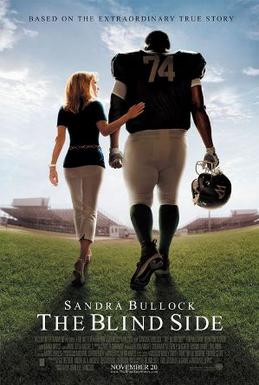
Here is Sandra Bullock taking Michael, and his life, into her arms.

Monday, March 3, 2014

A3 Blog #1: White Savior in The Blindside

The film I chose to examine is The Blindside, directed by John Lee Hancock, shows the characteristics of a typical White Savior film.  Sandra bullock serves the role of a White Savior by literally grabbing a young black teenager, Michael Oher, off the streets and taking them into their home.  She does everything in her power to keep "Big Mike" out of trouble and off the streets.  She is even portrayed as extremely brave, fearless, and strong when she goes into the ghetto to take Mike away from the gangs he was previously associated with.  Mike is a massive human and Leigh Anne, Sandra Bullock, decides to put him on the football team to get him involved in activities.  At first he isn't doing well in football, then Bullock once again is the "savior" and even begins coaching him and telling him to get "tough" and "mean".   Mike begins to excel in football and begins garnering scholarship offers from major college football programs.  Bullock helps him in his recruiting process so much so she even sways him to commit to Ole Miss, her Alma Mater.  This poses the question about her motives, did she really care about saving this kid from the streets, or was it a ploy of hers to improve the Ole Miss football team.  Of course, Bullock is seen this child's savior and a saint of a woman, especially when she fights off questions from her friends who tell her not to do this.  Bullock essentially takes Mike off the streets when he has no hope,  no direction, and no purpose in his life and transforms him into a highly coveted recruit who is able to play college football and ultimately turn pro--all attributed to Bullock.  At every stage of "Big Mike's" success, it is because of the essential role of the White Savior.


How much more White Savior can it get than this photo--Bullock reading a children's book to her young kid, and the grown-up Mike Oher?